Friday, August 13, 2010

A Rant On Food & Wine Pairing

Without fail, people ask me about wine and food pairing. They should. I'm a sommelier and my job is to help pair wine and food. Wine and food go together. It's a new-fangled concept that we sip wine on its own-- something that is a bit American in nature. Europeans enjoy wine as a food and don't have the strange history of Prohibition and government intervention around alcohol consumption that we have in the US. It's part of their everyday lives and wine drinking is as natural as eating.

In Europe, the local wine and food go together naturally. Getting wine in Italy, Spain, Portugal, or France is easy to do. Most likely your neighbor is making some if you live in the country, and if you live in the city, there is a bounty of affordable domestic wines from which to choose. Pairing is less of an issue when you go to Europe because most of the wine will be compatible with your meal -- the proprietor buys wines from regions that match his cuisine. I've been to Florence a few times (including living there in college), for instance, and I've never had a bad pairing. Tuscan wines go fabulously well with Florentine cuisine. I'd be curious to hear if you've been to Europe and had a bad wine/food experience. I've never heard of one (bad food, yes, bad pairing, no).

In the US we have much more diversity and therefore much more of a challenge with pairing. It's a little more complex given the bounty of preparations, fusion cuisine, and the staggering amount of wine available. Like everything else in wine -- it's totally overcomplicated here and is a pain in the arse to unravel.


I came face to face with this issue as I was preparing to do a tasting with a group that focused on wine and food pairing. I started doing research on the internet and in wine books to get some new ideas and suggestions.
Then I got really annoyed.

Wine pairings are decreed without explanation. WTF? People just throw out suggestions with nothing to back it up. To me, that's just words on a page that have no meaning. Is there a wine pairing mafia or is HAL 9000 from that 2001 movie doing all the pairings? It just is what it is.

When it comes to food pairing, wine and food critics and bloggers like to mandate the law like they were passing over the 10 Commandments to Moses. No explanation, no wiggle room, just a drumroll and BAM! here's your pairing. There are pairing generators and sites, critics that pride themselves on food and wine pairing expertise, and enthusiasts who issue wine and food pairings like they were army marching orders. The common thread: almost all of them tell us what we should drink and eat together with nary an explanation of why these things might fit. Hey guess what? I'm guilty of it too. I do it my posts every week. Shame on me.

Before I go further, I should tell you that I'm not of the school that you should drink anything with anything. I do think that there are certain food and wine combos that 90% of the population would find awesome. I've also come up with a few nasty-ass pairings before, where the wine has been replaced mid-meal because the acids clash, the wine is killing the food, or it just tastes bad to me and MC Ice. I like other people's suggestions and reasoning, but I'm not one for edicts. I don't like being told what to do without explanation (I'm sure after reading this blog you've pinned me for this type). I want to know
why the pairing works and it's a hard thing to come by.

As I searched for ideas on pairing -- something new or interesting, and something that would fit with the specific preparation of the caterer with whom I was working -- I got more and more irritated. I couldn't find one resource that talked about preparations of certain foods or sauces or matches between acids/tannins in the meat or seafood or veggies with certain wines. Yeah, I get that Pinot Noir and salmon go well together. Why, though? You'll be hard pressed to find an answer.


As we're all building our wine vocabulary and knowledge, I think it would help to cut the BS on random proclamations about food and wine pairing. Breaking things down to the
why can help everyone understand how to extrapolate and make better choices in pairing.

So I'm turning over a new leaf. From here on out, I am going to focus more on the pairing section of my posts. Since I do know about pairing from my experiences and studies, I'm going to start sharing. I'm going to tell you about the spices and preparation and why certain wines go well with certain foods. That way you can make choices for yourself based on what you're cooking (or what McD's drive through has, if that's how you roll), instead of taking an unexplained pairing doctrine and trying to make it work for you.

No time like the present for change, so I'll start today by talking about the pairings I made for my event...

Pairing 1: Seared Scallops in Butter Sauce with Sancerre from the Loire Valley
in France
Why it works: Scallops (when well-prepared) are lightly sweet and have a creamy textu
re. They melt in your mouth and are a tad salty when they are put with a butter sauce. Sancerre is a highly acidic Sauvignon Blanc and it's aromatic and fruity. The pear, tart apple, and citrus flavors of the wine bring out the sweetness of the scallops at first. Then the acid in the wine cuts through the creaminess of the shellfish and the butter to make your mouth feel clean and refreshed for the next bite. Also, if there is salt in the preparation, the mineral qualities of the wine temper the salt and integrate it into the creaminess the scallop.

Pairing 2: Mushroom Ravioli with Tomato Basil Sauce with Oregon Pinot Noir
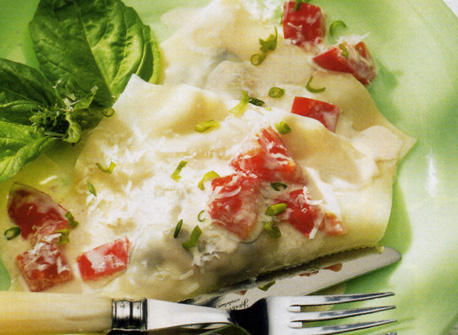
Why it works: Pinot is called the "chef's wine" because it goes with a lot of different foods. I absolutely love it with mushrooms because both are so earthy. They bring out the best in each other, and the sensation is a really woodsy, dark earth flavor -- which I love (MC Ice hates mushrooms so this is his own personal hell, BTW). If you are grossed out by eating potting soil, the other components in the dish come to the rescue: the starch will help absorb the fruitiness of the wine and the tomato sauce is acidic and brings out the acid in the Pinot. The sensation is something earthy yet fruity with mouth cleansing acid that makes the dish taste fresh, not heavy or like eating dirt.

Pairing 3: Beef Tenderloin and Roasted Portabello Mushrooms with Bordeaux (Cabernet Sauvignon & Merlot blend)
Why it works:
Beef tenderloin is just that -- tender in texture. It's soft protein and delicate yet still beef. Portabello mushrooms are the non-red meat eater's (I am a non red meat eater, FYI) analog to all things beef. Here, the classic pairing just works. Bordeaux is complex, with strong tannins that can work with the protein to make the texture of the meat less dense. The wine adds complex flavor (black fruit, tobacco, leather, cedar notes) to the meat's simpler preparation and the meat will soften the tannin of the wine as it's absorbed into the cut. The result is a satiny, soft texture that neither the wine nor the food will have on its own.

Pairing 4: Chocolate Fondue and Banyuls from the South of France
Why it works:
Let me be honest here, everyone has a different palate, but I thin
k the marketing ploy of pairing Cabernet and chocolate is horrible. The wine AND the chocolate taste bitter to me when I have them together and I need coffee to trump them both. That said, I have a massive sweet tooth and I love wine, so I found the perfect solution in this pairing. Banyuls is rich and full-bodied, and is made like Port. Fermentation is halted by adding brandy while there is still sugar in the wine. The finished product is sweet and alcoholic but in this case more delicate than a Port.

Usually dessert wine tastes best when it's sweeter than the dessert, so in this case we've got total perfection. The cho
colate makes the Banyuls taste like black plum, raisin, and black cherry and the Banyuls makes the chocolate taste like orange and espresso. No bitterness, just enhancement from the sweetness and the fruitiness of the wine with the choco.

I'd love to hear from you about good or bad pairings you've had. We'll try to dissect them and figure out why they worked so you can get more good pairings together, or why they didn't so you can avoid bad ones! Readmore »»

Friday, August 6, 2010

Greg Norman: A Good, Cheap Australian Chardonnay

I'm ditching the limerick this week for a quickie review because it's related to the post from earlier this week...the poor poetry will return next week.

So, I talked a ton about Australian wine earlier this week in my post on Torbreck Shiraz (and even included my video debut!) and I thought I'd follow up
that post with a review on a surprisingly solid Chardonnay from a big producer that I didn't expect to be good -- Greg Norman from the Eden Valley.

Eden Valley is about 1.5 hours from Adelaide in South Australia. It's adjacent to the famous Barossa Valley, which is known mainly for its Shiraz (Torbreck is here, BTW). Eden Valley, although less well known, was actually planted in 1842, the same year as the Barossa. The main difference: Eden is far from its name -- the Barossa is closer to perfection, for certain!

Located at higher altitude and with really bad and varied soil, which is great for viticulture, Eden Valley is much, much cooler than the Barossa. It's perfect for Riesling and Chardonnay (although further north in the valley it's hotter so quality Shiraz and Cabernet producers are here too, including Henschke, which makes the famous Hill of Grace). Here, the growing season is cooler and longer than Barossa, so mouth-stinging acid can develop alongside the fruit flavors in the grape, creating luscious dry Riesling and ripe yet balanced Chardonnay.

The biggest problem in this Valley, and why it hasn't enjoyed the recognition that the Barossa has had, is that with lots of different soil types, choosing the right kind of grape to grow is really hard -- this area isn't for the faint of heart. And there's less room for error here too -- although near the Barossa, this Valley is less developed, and it's lack of access to irrigation and extremely windy conditions mean lower crop yields and less finished wine. That's probably a good thing-- now and in the future we'll have fewer but better wines and those producers who do stick it out will make Eden Valley a consistent place for quality.


So onto the
bottle in question...I must admit that I never thought that my $12 cheapy of a wine, the Greg Norman Eden Valley Chardonnay would be any good. I know that's mean, but as I said in the last post, my experience has been that below $20 you're S.O.L. in Australia. I have liked some of the pro-golfer's line before, but I usually find Australian Chard to be big, oaky, and overblown.

Not so on this one.

To prove an exception to my own rule that you need be buying Aussie wine above $20, here's a quick review...


The Wine: Greg Norman Chardonnay
Where It's From:
Eden Valley, Australia
The Grapes:
100% Chardonnay
Vintage:
2008
Price:
$11.99

Color: A nice dark hay color, but not as golden as most Australian Chardonnays. The lighter hue had the hamster turning the wheel in my head. Could this be a non-traditional Aussie Chard? Something I could deal with? A non-oak bomb? I was feeling hopeful when I bought it and saw that it was from Eden Valley. The color allowed me to maintain optimism.


Smell: The pleasant surprise continued. Rather than big oak, I got citrus notes with just a little bit of light caramel (which is from the oak). I've rarely had an Aussie Chard that's restrained, but this smelled more like an Asian pear and minerals, with a touch of melon and light oaky vanilla rather than a 2 by 4 plank, overripe apple, and pineapple, which is what I would expect.

Taste: For a $12 bottle of Chardonnay, I give Greg Norman props. The fruit, oak, and acid were in balance. You could taste a great wet stone flavor in the wine and those melon, lime, and pear flavors were prominent but not overblown. Albeit a little too much caramel and vanilla bean for me (too much oak), the strong acid and the wine's lower levels of alcohol (only 12.5% as opposed to 14%, which many Napa and Aussie Chards have) provided balance.


Food: This is challenging. It's a little big for delicate foods. I had it with pasta primavera and thought it tasted overly alcoholic. I would have liked this with halibut or some richer white fish, and think it would be a great match with a stronger chicken dish or roast turkey.

Drink or Down the Sink?:
I would drink this again. It was so much better than what I thought it would be! If you have a friend/spouse/family member (not dog -- dogs can die from grape and wine consumption, FYI!) that loves oak and you hate it, this is your compromise wine! And for $12, that's pretty fab.
Readmore »»

Sunday, August 1, 2010

Torbreck Woodcutter's Shiraz: Australia's Proof of Greatness

At a tasting I did for some wonderful clients the other night, I poured an Australian Shiraz. It was well-received but then I got the question I get every time I pour Australian wines these days -- "Can you even get good Australian wine? I mean, isn't it all cheap, mass-produced stuff?" My heart broke a little for Aussie wine, but the question was completely appropriate and reflects the sad state of Aussie wine for a lot of wine drinkers these days.

So what happened to this giant of the wine industry that seems to have been usurped in popularity by stuff from South America, Spain, and even the rising stars of South Africa and New Zealand? Marketing happened. Too much marketing and not balanced enough marketing. Excess led to implosion.

Now, I've mentioned this before, but I have an MBA (go Tarheels -- I went to University of North Carolina!) and was a marketer/strategist for nearly 15 years. Even though wine is my passion and my career now, I am still a keen student of branding and marketing. So watching the rise and fall of Australia's marketing juggernaut has been particularly fascinating for me. My insights may be a little controversial, but I'm calling it like I see it.

As background, the Aussies started making wine in the 1820s - 1830s (although the first attempts were in the late 1700s when some dudes brought cuttings from South Africa -- another reason I think it's weird that we classify South Africa as New World. How can you be New World when you are established enough in the 1700s to be spawning whole industries on other continents? But I digress). This is when James Busby (the Scot pictured, left), who's termed the father of Australian wine, brought vine clippings from France and Spain. With this great raw material, the settlers figured out how to deal with the hotter than hell, sun-scorching (in most places) climate and got to business making some serious wines.

Unfortunately, like everywhere else in the wine world, in the 1870s that vine se
rial killer, phylloxera, hit. It's a bug that attacks the roots of vines, causing galls that result in mass murder of all things sacred in the vineyard and then multiplies like Charles Manson's disciples. In true American fashion, we caused the problem by spreading this louse from the Eastern US, but then we were also able to save the day by providing roots that were resistant to the bug and could have European grapes grafted on them without a change in flavor. It was a real boo/rah moment.

Whereas everyone else in the world picked up the memories of their shattered wine lives and decided to go back to making normal, awesome wine post-phylloxera, the Aussies got stuck and for about 100 years just made sweet wine, which they termed "stickies." Even their most famous and revered wine, Penfold's Grange, which is dry and unbelievably delicious was made under cover of night in the 1950s. Although Grange and a few others worked out ways to make dry wine, it wasn't until the 1980s that Australia as a whole had its coming out party.

It was then that the marketers got to work and Australia bet the farm on making high quality, inexpensive wine. Wine drinkers loved it. They bought in droves and the ride began. In the early 2000s exports increased 35 times what they were in the 1990s. Why? People around the world dug this stuff. It was fruity, mouth-filling, and most wasn't too complex...and it was cheap. What a great starter wine for people just getting into this kind of intimidating world!

The problems then arose (BTW, I kind of feel like a "Behind the Music" writer for VH1..."and then disaster struck when Ozzie Osbourne did an 8Ball one night..."). In the early 2000s every wine coming out of Australia was a so-called "Critter Wine" -- with the success of Yellow Tail I'm convinced that all the people that marketed those lameass Beanie Babies (oh yes, I did go there) lost their jobs when that craze was over and migrated to Australia to make up stupid critter names for wine brands. Pretty Penguin, Kuddly Koala, Wombat Wine, Kangaroo Kitsch (I making this up, but I'm not too far off) were manufactured to make us buy based on label. We all fell for it.

Then we all got over it. Many of us also got tired of these big, jammy wines. We wanted something more complex and interesting. We got our start in Australia, but we set our sights on Latin Lovers -- Spain, Chile and Argentina, and back on our old flames California, Italy, and France.


Uh-oh -- now what? Australia had staked its whole positioning on affordable wines with cute labels. Maybe they reasoned that Disney had been around forever with the cutsy thing. I mean couldn't Australia have that longevity based on their version of Mickey Mouse for wine? We voted with our dollars. No. The bloom was off the rose.

That's not to say that we were done with Australia, but it is to say that the exuberance was over and their industry started to feel it. I can tell you that the hot Australian brands at the large hulking winery that I used to work for didn't get the attention they used to. Money was redirected to Spanish and Argentinean brands, and back to funding successful California brands.

So that leads me back to the question I get frequently -- "Can you even get good Australian wine? I mean, isn't it all cheap, mass-produced stuff?"

And here's the answer. Although you can still get cheap, mass-produced stuff, Australians are not dumb. They know what happened and they are working to right the ship. They are focusing on re-branding. They are trying to let us know that they are dedicated to quality and to growing grapes in the best possible areas instead of everywhere there is available space that can be irrigated.

They're actually learning from their upper tier, I think. There are a few producers that have been leading the way and who haven't been slammed as badly as the lower tier producers. The success of Penfold's with Grange, Henschke with Hill of Grace, Clarendon Hills with Astralis, D'Arenberg with Dead Arm, and Torbreck with Run Rig show that first class wines can come from Australia and can command a premium. But they prove that care and feeding must be given.

Although I didn't have the Run Rig, I did have the delightful experience of tasting Torbreck's Woodcutter's Shiraz .

Before I get to the wine, I need to tell you that this is a freaking cool winery. David Powell, the founder and winemaker, was studying to be an accountant in Adelaide, following in his father's footsteps but he really loved wine. In his time off, he would go work at the wineries in the Barossa. The guy took his walkabout and wound up travelling to the great wine regions of Europe and even spending some time as a lumberjack in the Torbreck forests of Scotland (hence, the name). When he went back to Australia, he decided to go for it. He realized that there were a ton of neglected Barossa Valley properties that had old vines on them but weren't being maintained. He approached the owners to ask if he could work the land. Powell did this at a few farms and his first vintage launched in 2003, with great results. Torbreck is now iconic for the Barossa -- all hand-harvested wines that are highly rated and classic for the region.

So what does a good wine from Barossa taste like, here's what I thought of their base tier wine, the Shiraz:
The Wine: Torbreck Woodcutter's Shiraz
Where It's From:
Barossa Valley, Australia
The Grapes:
100% Shiraz
Vintage:
2008
Price:
$21.99

Color: Like most Australian Shiraz this wine was not shy on showing its color. It was nearly opaque and blood red. It stained the glass, it was so rich in color. The wine was nearly vampiric in appearance (any other Twi-hards out there? Sorry for the reference). Thi
s amount of color usually indicates big flavor, so I braced myself for the smell and taste of this.

Smell: Absolutely typical for a Barossa Valley Shiraz. Rich oak and ripe boysenberry just flooded out of the glass after a good swirl. There was a prune or raisin note to the wine, and lots
of alcohol burn -- a cilia singer. There were these unbelievable black pepper, licorice, and bacon aromas (all from the grape -- Syrah/Shiraz often develops these delicious smells with time). The aromas imparted from the oak were unreal. Warm cinnamon and nutmeg, rich roasted coffee beans, savory herbs cooked in butter, and an aroma of maple or tree sap just made my mouth water. Complex aromas usually = unreal wine.

Taste: Torbreck did not disappo
int (nor did I expect it to, given the reputation of the producer and the fact that they care so much about their wines!). Black cherry, boysenberry, and even a little black raspberry fruit flavors were so awesomely balanced with a bitter chocolate, nutmeg, cinnamon, coffee thing. But what made this wine so complete and different from a lot of Australian Shiraz -- it actually had a great balance of mouth-watering acid and mouth-drying tannins. What a beautiful thing.

Food: Here's a perfect match for roasted and grilled meats, and heavy beef or mushroom dishes. I do also think it will be equally at home with Mexican, greasier food, and anything from the barbecue. A really versatile food wine.


Drink or Down the Sink?:
Drink it! This wine is evidence that Australia is not all about cheap 'critter wine' or Yellow Tail. When you get a quality producer who takes times with the vines and knows the land, they can produce a wine that proves Australia's future is in boutique wine that is made well and has a beauty and style all its own.

PS -- You may want to decant this wine (just pour it in a glass and leave it out) for an hour or so before drinking. Although I lov
ed it, I found it was better the day after I opened it!
Readmore »»

Monday, July 26, 2010

My Voice of Dissent on Riedel in IntoWine.com and the Normal People's Guide to Glassware

I'm not a fan of confusion or complexity in wine...or glassware.

Please check out this IntoWine.com article where I discussed the issue with the lovely and talented Nancy Parode (I'm quoted on Page 2). Following in the footsteps of my dad, and oft quoted and controversial education specialist, I am, of course, the voice of dissent in this otherwise very positive view of Riedel stemware. Check it out...

INTOWINE.com ARTICLE:


In my world, I think you need 3 types of glasses (4 if you're really into wine):
1. A white glass that tapers at the top to concentrate aromas and deliver them better to your snout.


2. A red glass that has a big bowl and a wide rim so you can aerate that puppy and unlock the aromas in the glass with a good swirl.


3. A Champagne flute if you drink bubbles. The narrowness of the glass preserves the bubbles and concentrates the luscious scents.


The 4th optional choice -- if you are really into red wine, you could get a big ass Bordeaux glass to allow for in-glass decanting and full aeration, but it's not really necessary...the Burgundy glass will work fine as long as you swirl well.


It shouldn't be that complicated. I mean, who among us has more room than they know what to do with in his/her kitchen? Few, I think. We certainly don't need separate glasses for everything we drink, as some may tell you.

Purchase good quality glass and stick to 3 shapes.

Now you're good to go.
Readmore »»

Tuesday, July 20, 2010

Torii Mor 2009 Pinot Gris: Sadly, Just Ok

So last week I reviewed the Torii Mor Pinot Noir from the Willamette Valley of Oregon, a wine that I love. Coupled with the fact that the wine is solid, the bottle has special significance because it was given to me by Margie Olson herself, the owner of Torii Mor and a very sweet and lovely woman. On this same occasion she gave me a bottle of the winery's Pinot Gris, which made me very excited because I adore Oregon Pinot Gris.

Unfortunately, this bottle fell short of expectation.

If yo
u want to know more about Torii Mor and Oregon, please check out my post on their Pinot Noir, where I go into detail. Given that I've already been to that rodeo, I figured I'd talk about Pinot Gris or Pinot Grigio, as it's also known.


To start, a couple basics on the grape:

1. It's a clone of the ever mutating Pinot Noir (read=it too, is a pain in arse to grow)
2. Given #1, it makes sense that Pinot Grigio is actually not a green grape, but a grey-blue grape
3. Pinot = Pinecone in French. Wines derived from Pinot Noir are from clusters of grapes t
hat look like pinecones.Simple, no?
4. Gris = French for grey (see point 2)

5. Grigio = Italian for grey (see point 2, again)
6. Pinot Gris morphed from Pinot Noir in its native home of Burgundy. It was first discussed in the Middle Ages. Given its temperamental nature, it
was abandoned in Burgundy and in Champagne (where it was part of the blend for bubbly) for the heartier Chardonnay.

As a side note, I'm not sure why they decided that Pinot Gris/Grigio is made as a white wine. I mean, it's really hard to prevent the juice from touching the skins and picking up color. I guess winemakers want a challenge...

7. I know I already said this, but just to be sure...Pinot Gris and Pinot Grigio are the same grape -- you say potato...I say pohtahtoe (phonetic spelling, of course).

The grape is super-sensitive to where it grows, and depending on where it's made it tastes like a completely different wine. You may be sick of my bullets, but I'm in the mood to keep on with my lists, so here's a little guide:

Alsace, France: Full-bodied, rich, floral, spicy, honeyed, smoky, and oily-textured wine. It jumps out of the glass with its aroma, is unctuous but with decent acid and a beautiful match for food. There's lots of sun in Alsace, and the grapes get ripe and delicious. The most complex and showstopping Pinot Gris in the world, methinks.


Oregon: Kind of like Alsace light, it can be pinkish (per my point above, hard to keep the skin away from the juice) and taste less floral and more like apple and Asian pear. The wine is at least medium-bodied and fruity and full. I'd call it a pretty wine -- aromatic and flavorful but also with decent acid so it's not flabby.


Italy: Mostly from cooler, northern Italy, this wine is lean, to say the least. It's lemony, acidic, crisp, and so mineral-like it's like face-planting in a mountain stream. It can be really thin, sometimes watery, and usually lacks the lush flavors and aromas you're going to find in Alsace and Oregon Pinot Gris. I usually find it to be insipid, crap stuff -- even if it costs $24 like one major brand we may all know. California tries to mimic this style, given its popularity.


Although I love Ramona Singer from the Real Housewives of New York and her hilarious Pinot Grigio habit, I gotta say I'm not a fan of watery, acidic, lemon juice. I prefer Pinot Gris to Pinot Grigio.

So, I was pumped for the Torii Mor Pinot Gris, given how much I loved their Pinot Noir. How surprised was I when I discovered that this wine was made in the Pinot Grigio style? Very surprised, and less than happy. Here's the rundown:

The Wine: Torii Mor Pinot Gris
Where It's From:
Willamette Valley, Oregon
The Grapes:
100% Pinot Gris
Vintage:
2009
Price:
$16.00

Color: Brassy but nearly white and very reflective, the color gave me pause. Most Oregon Pinot Gris that I like is saturated in color -- like straw or brass. This was much lighter than normal and way too light to have the kind of flavor I was expecting. Uh-oh.

Smell: Similar to Italian Pinot Grigio, there wasn't much but a slight white flower and lemon-lime smell. There was none of the honeysuckle, apple, or pear that I'd want or expect from a Pinot Gris. More evidence leading to a not-so-great conclusion. Where's the beef?

Taste: More like a lower quality un-oaked Chardonnay than Pinot Gris, there was a brief sensation of acid, mineral and lemon-lime with a touch of green apple, but I'd say what was in this bottle was just white wine. Could have been a $7 white blend for its lack of distinction and character. I expect more from Oregon and certainly more from a producer of fine Pinot Noir.


Food: I guess if you like Pinot Grigio from Italy, you would just chill this sucker down and sip it before a meal or have it with a salad.

Drink or Down the Sink?:
Meh. Not great, not horrible. For $16 you can do a lot better. Torii Mor should take a page from some other great Pinot Gris producers in the area. In it's quest to be differentiated, it's created a style that is definitely un-Oregonian, and, to my palate, boring and blah.
Readmore »»

Friday, July 16, 2010

Friday Limerick: Homage to Gamay From Reader Rob Van Leer!

I love the enthusiasm! My friend and loyal blog reader Rob Van Leer from Atlanta has put his rapier wit to the test and composed the lovely wine limerick below. Inspired by Carol's (his wonderful wife) enjoyment of a Beaujolais tasted Monday, Rob has provided us with this fun composition...

Friday for Gamay
An oft overlooked grape is Gamay.
Its greatest fame lies in Beaujolais.
The wine is not serious,
But the aroma leaves you delirious,
And chases your troubles away!


Couldn't have said it better myself! Please submit your limericks to me and I'll post them up on Friday for all to see!

The Wine Inspiration: Louis Jadot Beaujolais-Villages
Vintage: 2009
Where's it From:
Beaujolais, Burgundy
The Grape:
100% Gamay
Price: $10.99
Readmore »»

Thursday, July 15, 2010

My Wine and Cheese Pairing Featured in The Travel Connoisseurs

A quick post to let you know that I've been featured in a great article: "Top 10 Best Wine and Cheese Pairings" in The Travel Connoisseurs, an amazing site that features "cocktails, cuisines, accommodations, and travel tips."

Thanks to Lee for including me in this piece!


PS -- Friends may recognize the lovely scene next to my suggestions from a certain Atlanta porch. MC Ice is a great amateur photographer! Readmore »»